Sunglasses Size Chart: Small, Medium, Large and XL
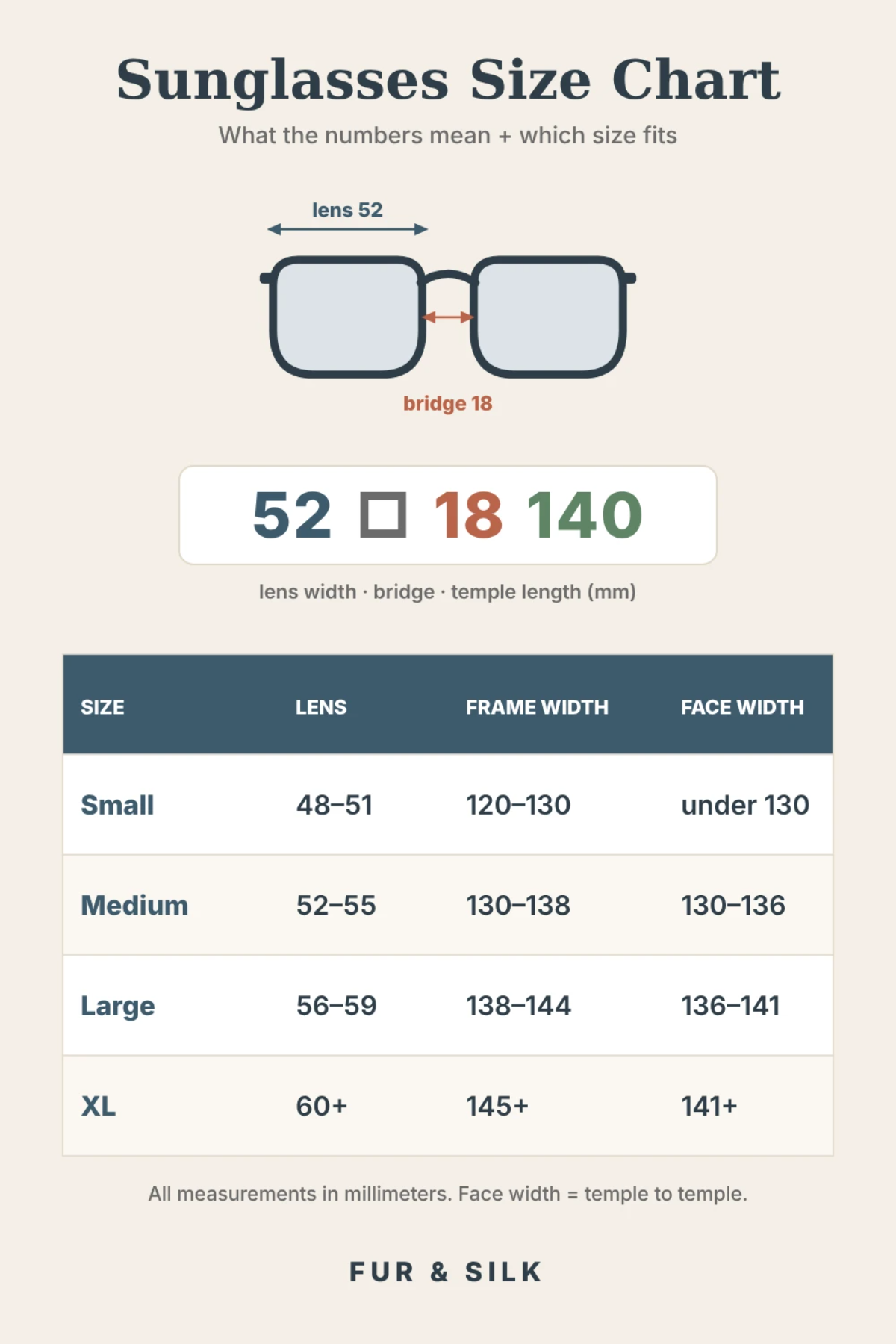
Sunglasses sizes are not printed as small or large, so the chart below translates the measurements into the size names most people shop by. Lens width is the number most brands use to label a size, but the total frame width is what decides whether a pair actually fits. The last column connects the two: measure your face width once, find your row, and you have the lens, bridge and temple ranges to look for. Many one-size frames are cut in the medium range, so if most sunglasses already fit you, that is probably your row.
Not sure of your face width? The size finder below converts it for you in millimeters, centimeters or inches. If you have never measured, the steps are in the face section further down.
How to Read the Numbers on Sunglasses
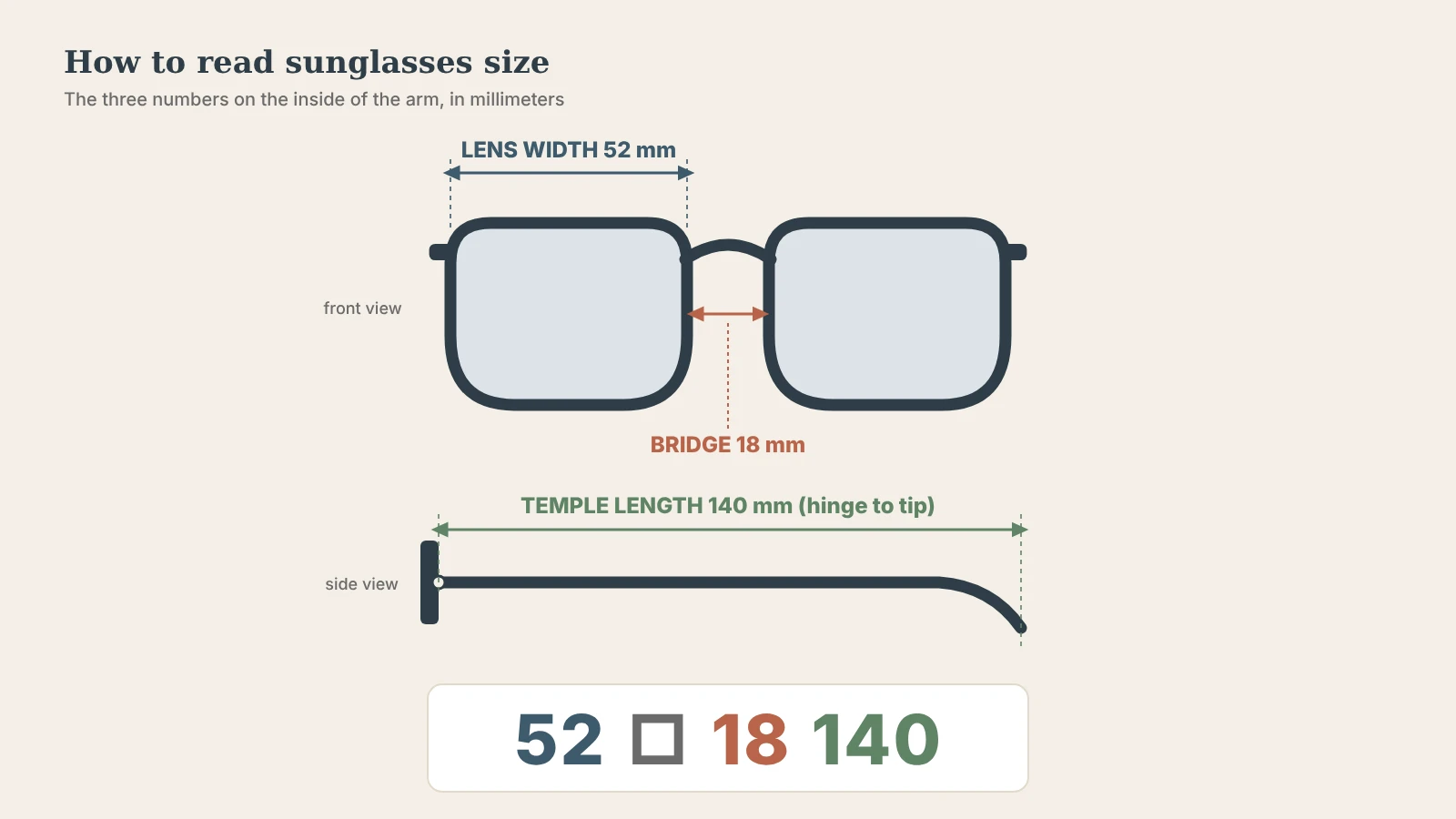
Sunglasses size numbers follow the same order on almost every frame: lens width, then bridge width, then temple length, all in millimeters. A pair marked 52□18 140 has 52mm lenses, an 18mm bridge and 140mm arms. The colors in the decoder below match the diagram at the top of this page, so you can see exactly where each measurement is taken. When two numbers are close together, the first is always the lens.
Lens Width
Lens width is the horizontal width of one lens at its widest point. It is the main size number and usually falls between about 40 and 60mm, with some oversized and sport frames going wider. Because there are two lenses, every extra millimeter here adds about two millimeters to the total width of the frame.
Bridge Width
Bridge width is the shortest distance between the two lenses, measured where the frame rests on your nose. Most bridges fall between about 14 and 24mm. A bridge that is too wide lets the frame slide down; one that is too narrow pinches and pushes the lenses up toward your brows.
Temple Length
Temple length is the length of each arm, measured from the hinge to the tip behind the ear, including the curve. Temple lengths usually run from about 120 to 150mm. Short arms pull the frame forward; long ones leave the tips loose behind your ears.
Where to Find the Size on Your Sunglasses
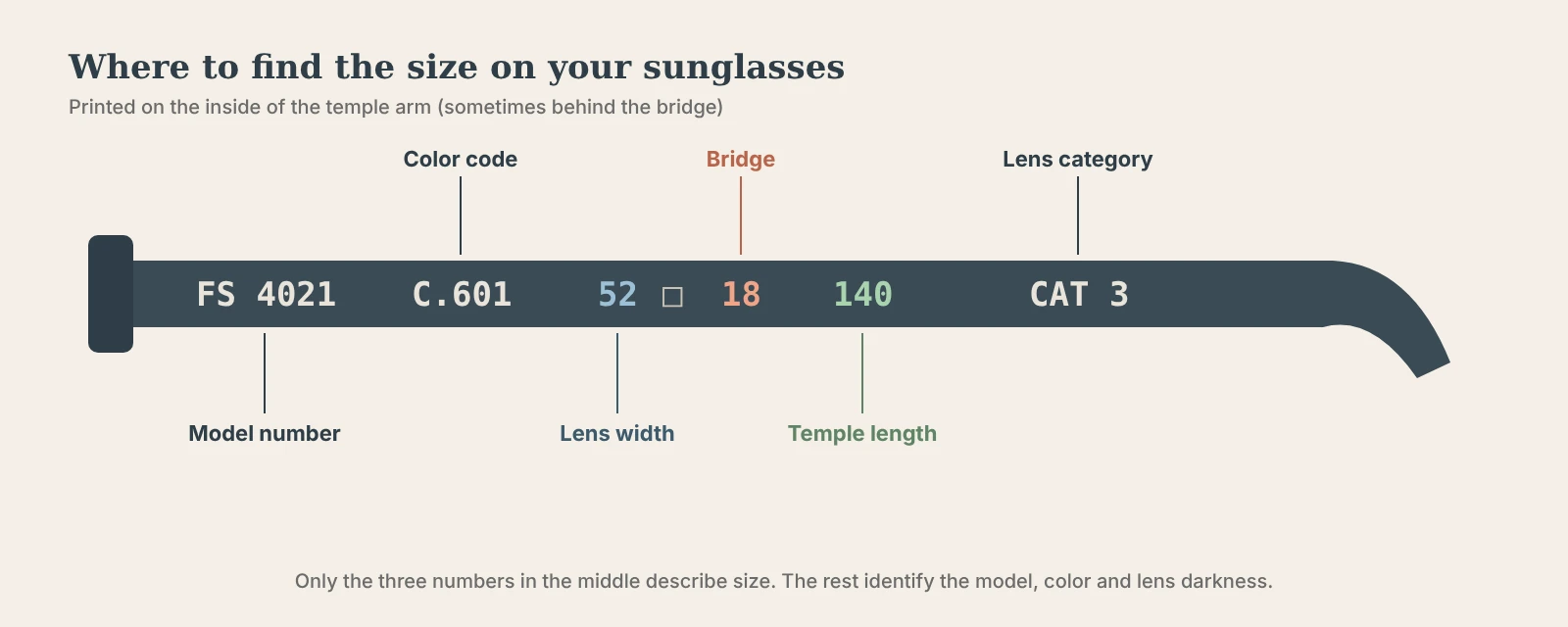
Look on the inside of the left or right temple arm first. Some frames print the size behind the bridge instead, and a few small or rimless styles leave it off entirely. In that case, you can measure the pair yourself, as shown in the next section.
What the Square Symbol Means
The small square between the first two numbers tells you the frame was measured with the boxing system, where each lens is measured inside an imaginary rectangle drawn around it. The method is set out in the international standard ISO 8624. Some brands print a dash or a space in the same spot; the numbers are read the same way.
Other Codes on the Temple Arm
The size usually shares the arm with a few other markings. The model number identifies the frame design, the color code identifies the frame and lens finish, and a CAT number from 0 to 4 shows how dark the lens is. None of these change the size, but the CAT number and any UV400 marking matter for how the lens performs in bright light.
How to Measure Sunglasses
If a pair has no printed size, or you want to know the full width of a frame that fits you well, you can measure sunglasses with a ruler in about a minute. Lay the pair upside down on a flat surface, lenses facing you, and measure in millimeters.
1. Lens width. Measure straight across one lens at its widest point, from the inside edge of the rim on one side to the inside edge on the other.
2. Bridge width. Measure the gap between the two lenses at the point where they come closest, just above the nose pads.
3. Temple length. Open one arm and measure from the hinge screw to the very end of the tip. A soft tape follows the curve more easily than a ruler.
4. Total frame width. Measure straight across the front, from the outer edge of one hinge to the other. This number is rarely printed, but it is the one you will compare with your face. As a quick estimate, double the lens width, add the bridge and add about 8mm for the end pieces.
When you shop with those numbers, small differences do not matter much. The table below shows how close a new pair needs to be to feel like the one you already own.
How to Measure Your Face for Sunglasses
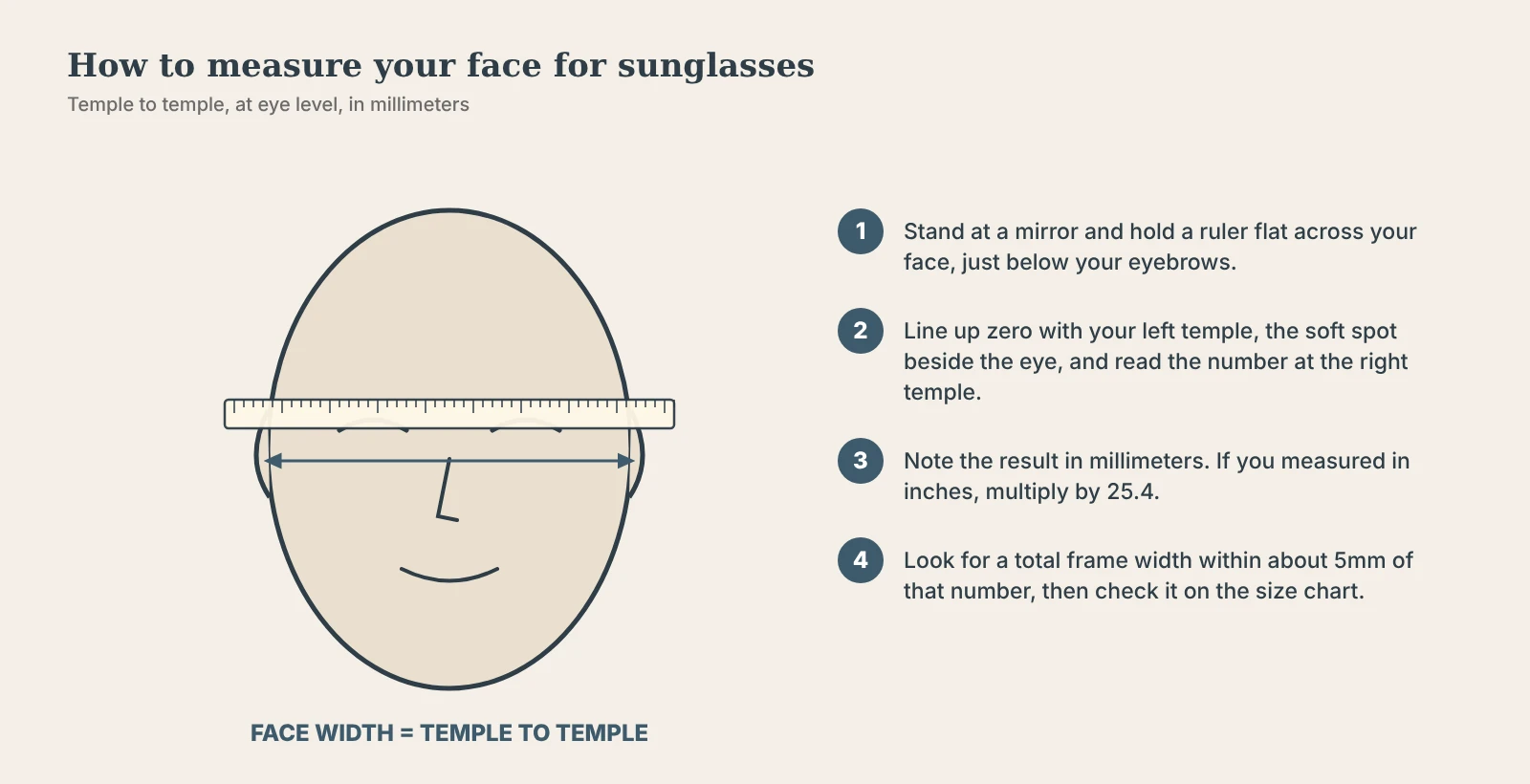
Your face width is the number that connects you to the size chart. It is measured from temple to temple, across the soft spots just outside the corners of your eyes, at about eyebrow level.
The ruler method. Stand at a mirror and hold a ruler flat across your face, just below your eyebrows. Line up zero with one temple and read the measurement at the other. A second person makes this easier and more accurate.
The pair-that-fits method. If you already own sunglasses that feel right, measure their total frame width instead. That number is a reliable target for your next pair, and it already accounts for how you like a frame to sit.
Measuring for temple length. To check arm length, run a soft tape from the outer corner of your eye back along the side of your head to the point just behind the top of your ear. Compare the result with the temple column in the size chart.
Once you have your face width in millimeters, find it in the last column of the chart, or enter it in the size finder above. If you measured in inches, multiply by 25.4 to convert.
What Does 55mm Mean on Sunglasses?
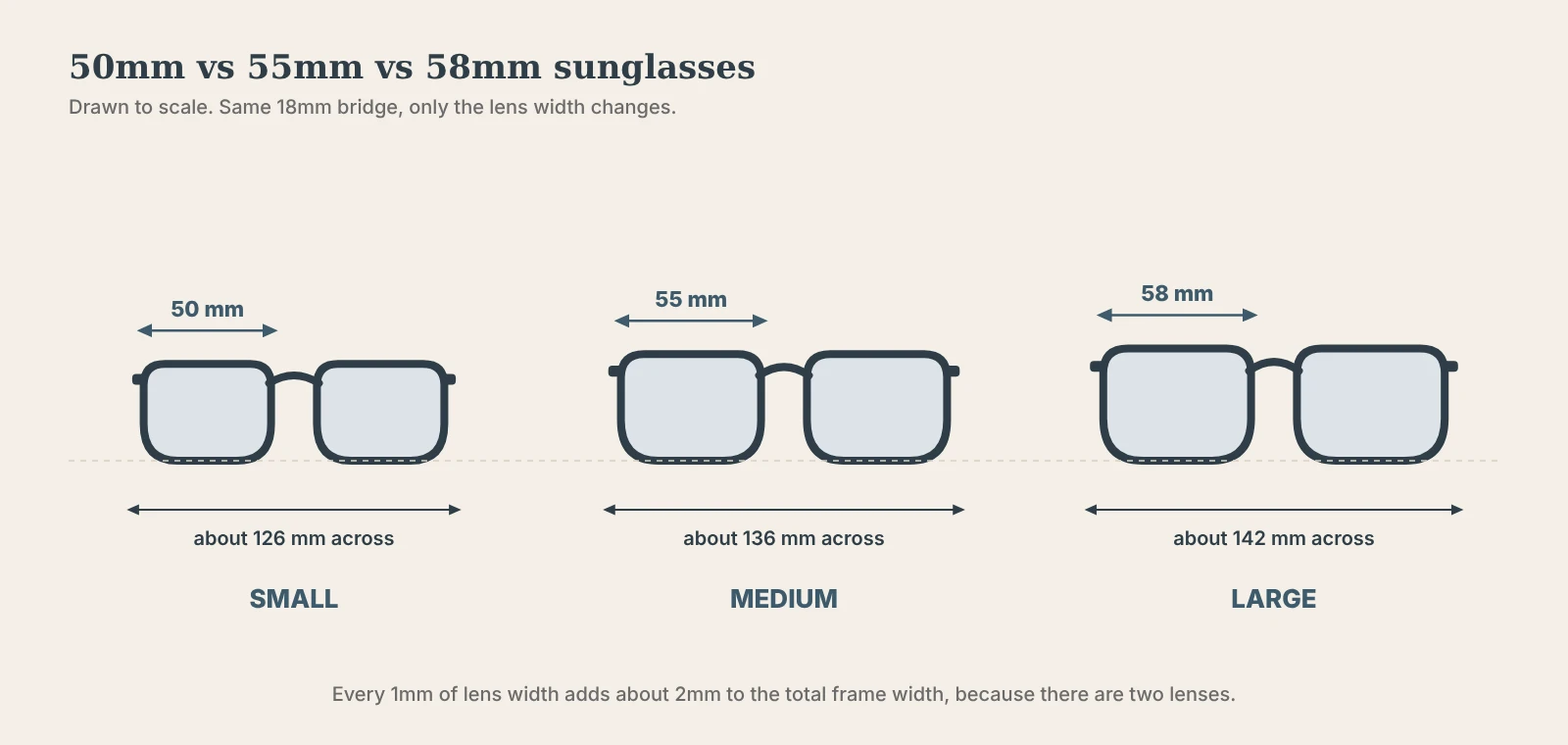
When a listing says 55mm, it means the lens width: each lens is 55mm across at its widest point. That makes it a medium, toward the larger end of the range. A 58mm lens is a large, and a 50mm lens is a small.
The difference looks minor on paper, but it doubles across the frame. Moving from 55mm to 58mm adds about 6mm to the total width, which is enough to change how far the frame reaches toward your temples. That is why the same style is often sold in two or three lens widths, and why choosing the right one matters more than it first appears.
Lens height changes with lens width, too. A larger lens covers more of the area around the eye, which is useful in strong sun but can sit on the cheeks if the face is short or narrow.
Parts of Sunglasses (Labeled Diagram)

Knowing the anatomy of sunglasses makes product descriptions easier to read and fit problems easier to fix. The diagram labels every part on the front and side of a pair, and the table explains what each one does for fit.

How Sunglasses Should Fit
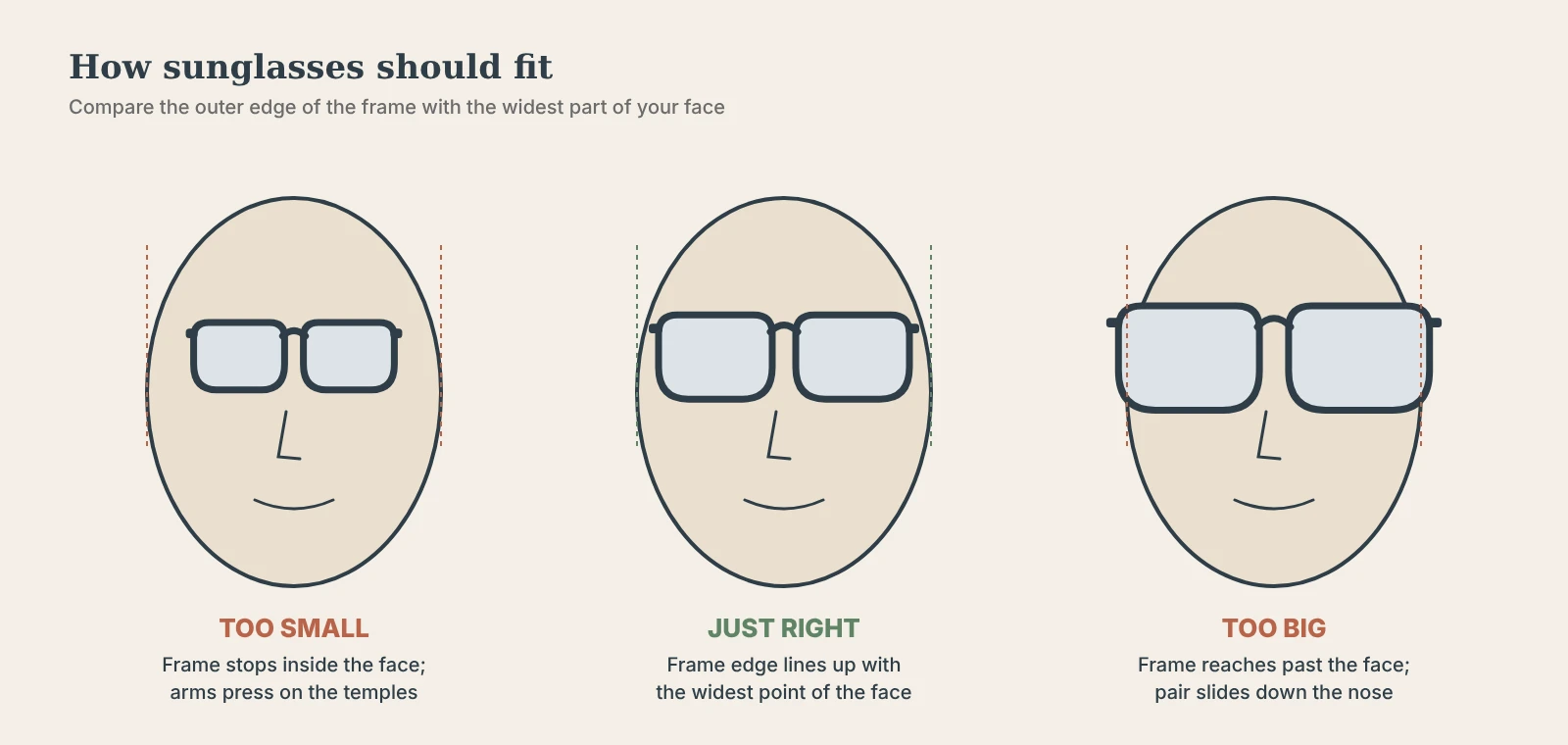
The quickest fit check happens in a mirror. The outer edges of the frame should line up with the widest part of your face, your eyes should sit near the center of each lens, and the pair should stay in place when you look down or smile.
Signs a pair is too big. The frame extends past the sides of your face, slides down your nose, or rests on your cheeks. Gaps between the arms and your head are another clue. A smaller lens width or narrower bridge usually solves it, and petite faces often need both.

Signs a pair is too small. The arms press against your temples or leave marks behind the ears, the frame looks narrow against your face, or the lenses sit high toward your brows. Look for a wider total frame width and longer temples.

When bigger is the point. Oversized sunglasses are designed to reach past the face for coverage and drama. Even then, the bridge and temples should fit, so the frame stays level instead of sliding.


Frequently Asked Questions About Sunglasses Sizes
What does 52□18 140 mean on sunglasses?
It means each lens is 52mm wide, the bridge between the lenses is 18mm and each temple arm is 140mm long. The small square shows the frame was measured with the boxing system, the method defined in ISO 8624. Some brands print a dash or a space instead, and the numbers mean exactly the same thing. If you have seen it written as "52 rec 18," the "rec" is that square being read as a rectangle.
What is the standard size for sunglasses?
There is no official standard size for sunglasses. In practice, many adult frames are made in the medium range: a lens width of about 52 to 55mm, a bridge of 16 to 20mm and temple arms of 135 to 140mm, which adds up to a total frame width of roughly 130 to 138mm. One-size styles usually aim at this middle range because it suits the widest group of faces.
Is 55mm a small, medium or large?
A 55mm lens width is medium, at the upper end of the range. With an 18mm bridge, it usually works out to a total frame width of about 136mm, which suits faces roughly 130 to 136mm wide from temple to temple. Frames with lenses from 56mm up start to wear as large. If a 55mm pair feels slightly loose, a 54mm version of the same model is the next step down.
How do I know if my sunglasses are too big?
Sunglasses are too big if the frame reaches past the sides of your face, slides down your nose when you look down, or rests on your cheeks when you smile. A gap between the temple arms and the sides of your head is another sign. A smaller lens width or narrower bridge usually fixes it. Oversized styles are meant to extend a little past the face, but they should still stay put on the nose.
Are men's and women's sunglasses sizes different?
The numbers are measured the same way for everyone, and many frames are unisex. Women's collections often start at smaller lens widths, while men's lines tend to run wider, but the label matters less than the measurements. Compare the total frame width with your face width instead of shopping by the tag. This is especially useful if your face is wider or narrower than average, since the right size may sit in the other collection.
How wide should sunglasses be for my face?
Sunglasses should be about as wide as your face, measured temple to temple, or a few millimeters wider. A total frame width within about 5mm of your face width usually sits level without pinching. Much narrower and the arms press on your temples; much wider and the frame tends to slip. Spring hinges add a little give, which helps if you fall between two sizes.
Do sunglasses sizes vary by brand?
The three numbers are measured the same way across brands, so a 54mm lens is 54mm everywhere. What changes is the shape. A round 54mm lens and a square 54mm lens cover different amounts of your face, and two frames with matching numbers can sit differently on the nose. Use the numbers as your starting point. Then compare the lens height and bridge style, since those decide how the pair actually sits.