How to Tell If Ray-Bans Are Real: 8 Checks
Go through the checks in order. The first three take a few seconds and catch most cheap copies; the rest separate a well-made fake from the real thing. Look at everything together, because a counterfeiter can get one or two details right but rarely all of them.
1. Look for the RB Etching on the Left Lens
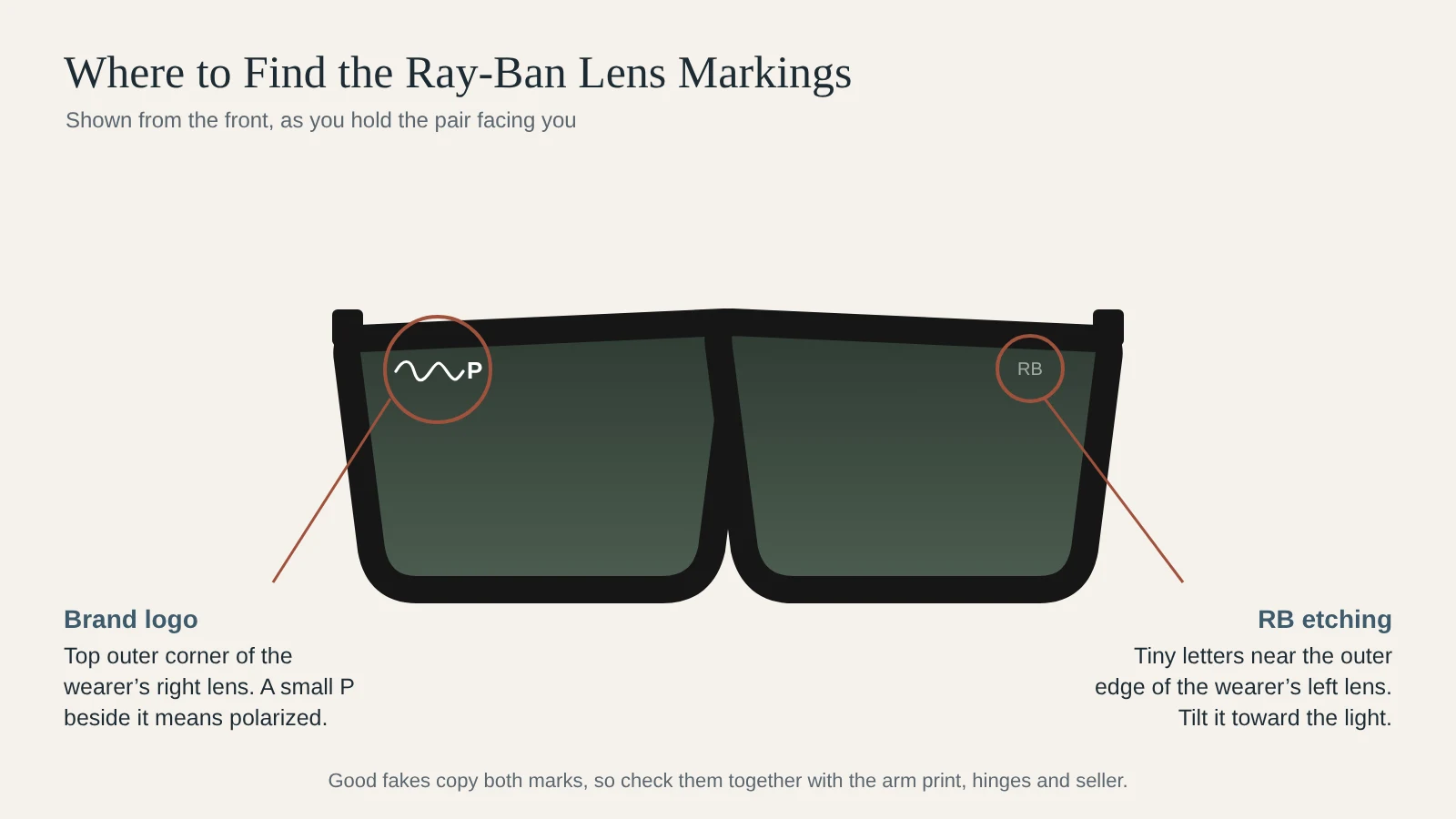
Genuine Ray-Ban lenses carry two tiny letters, RB, etched into the glass or plastic near the outer edge of the wearer’s left lens. The etching is so faint that you usually need to tilt the lens toward a lamp or window to see it. Run a fingernail over it: real etching is part of the lens, while a printed or stuck-on RB sits on top and can rub off. The etching on its own proves little, because many fakes copy it, but a pair without it should make you suspicious.
2. Check the Logo on the Right Lens
The Ray-Ban logo sits at the top outer corner of the wearer’s right lens, in crisp white or gold script. On a genuine pair the letters have clean edges and even spacing. A blurry, thick or slightly crooked logo is a warning sign, and so is one that peels or scratches away. Polarized pairs add a small P right next to the logo. If the tag promises polarized lenses but there is no P, check the arm code and our guide to every Ray-Ban lens type before you trust the label.
3. Read the Print Inside Both Arms
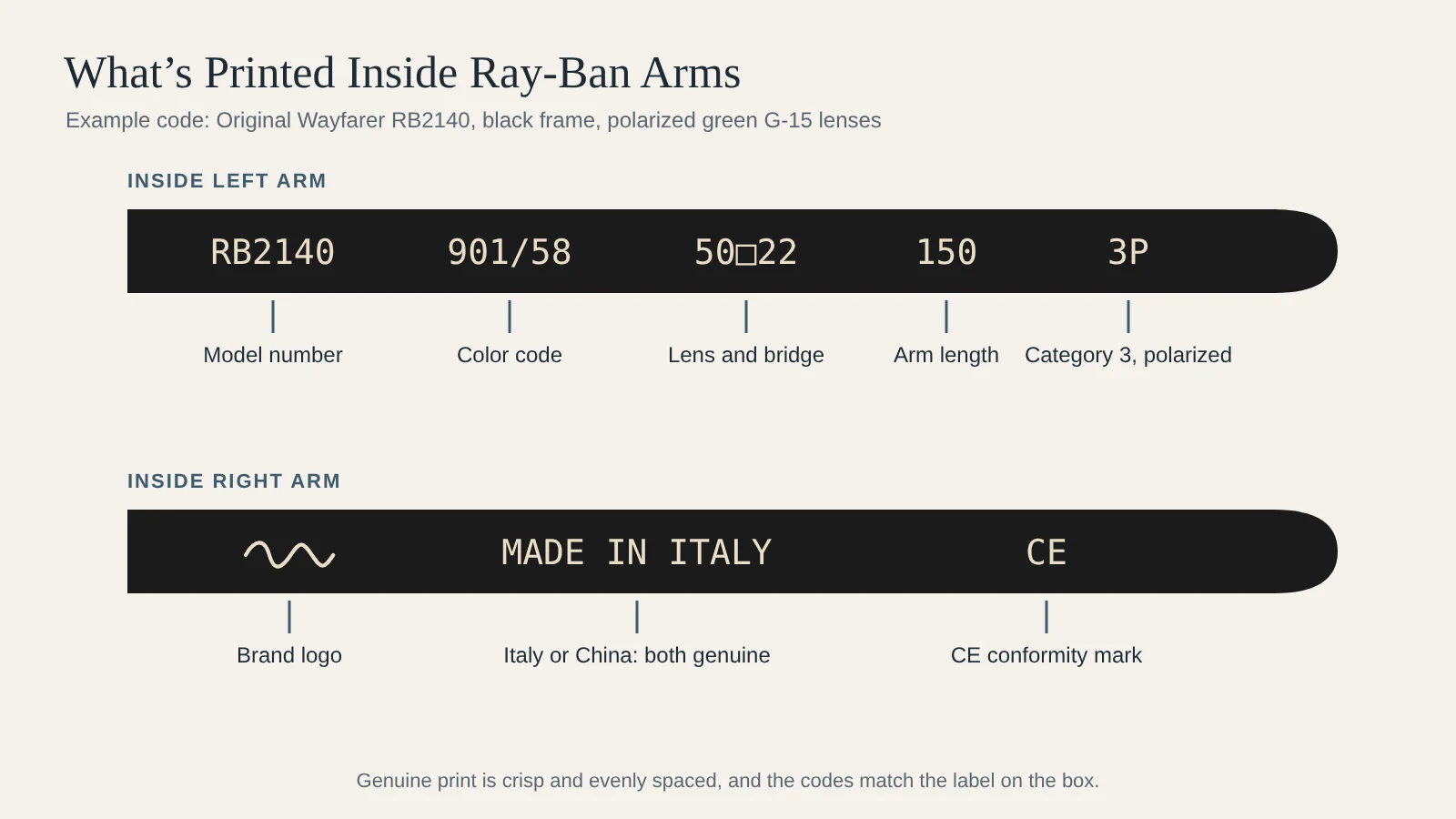
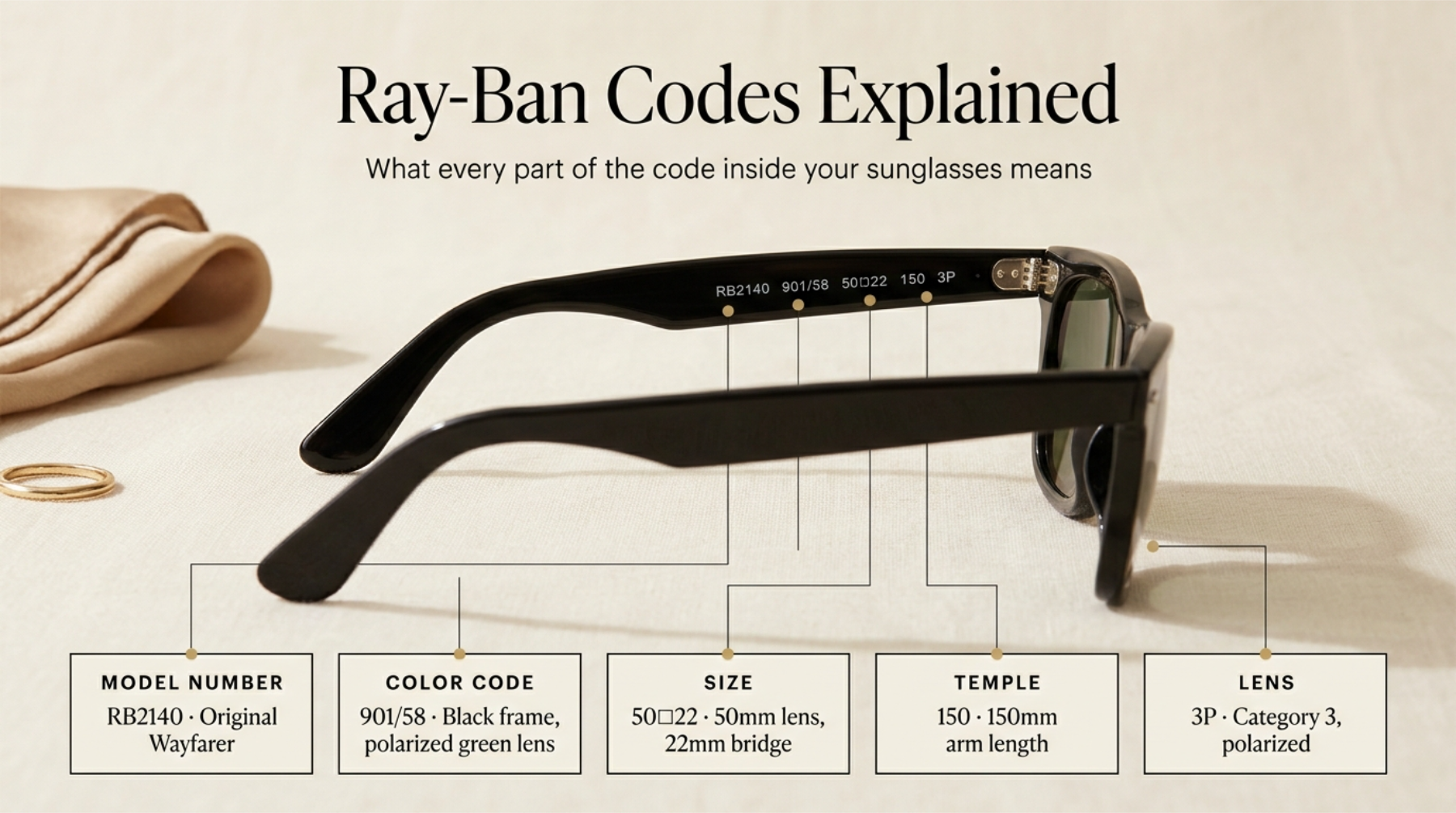
Open the sunglasses and look inside the arms. The left arm carries the model number, color code, size and lens code, such as RB2140 901/58 50□22 3P. The right arm shows the logo, the country where the pair was made and the CE mark. On real Ray-Bans this print is sharp, evenly spaced and straight. Smudged letters, uneven spacing, missing codes or a code that does not match the shape and color of the frame all point to a copy. To check what each part of the code should say, use the decoder in our guide to reading Ray-Ban codes.
4. Test the Hinges and Screws
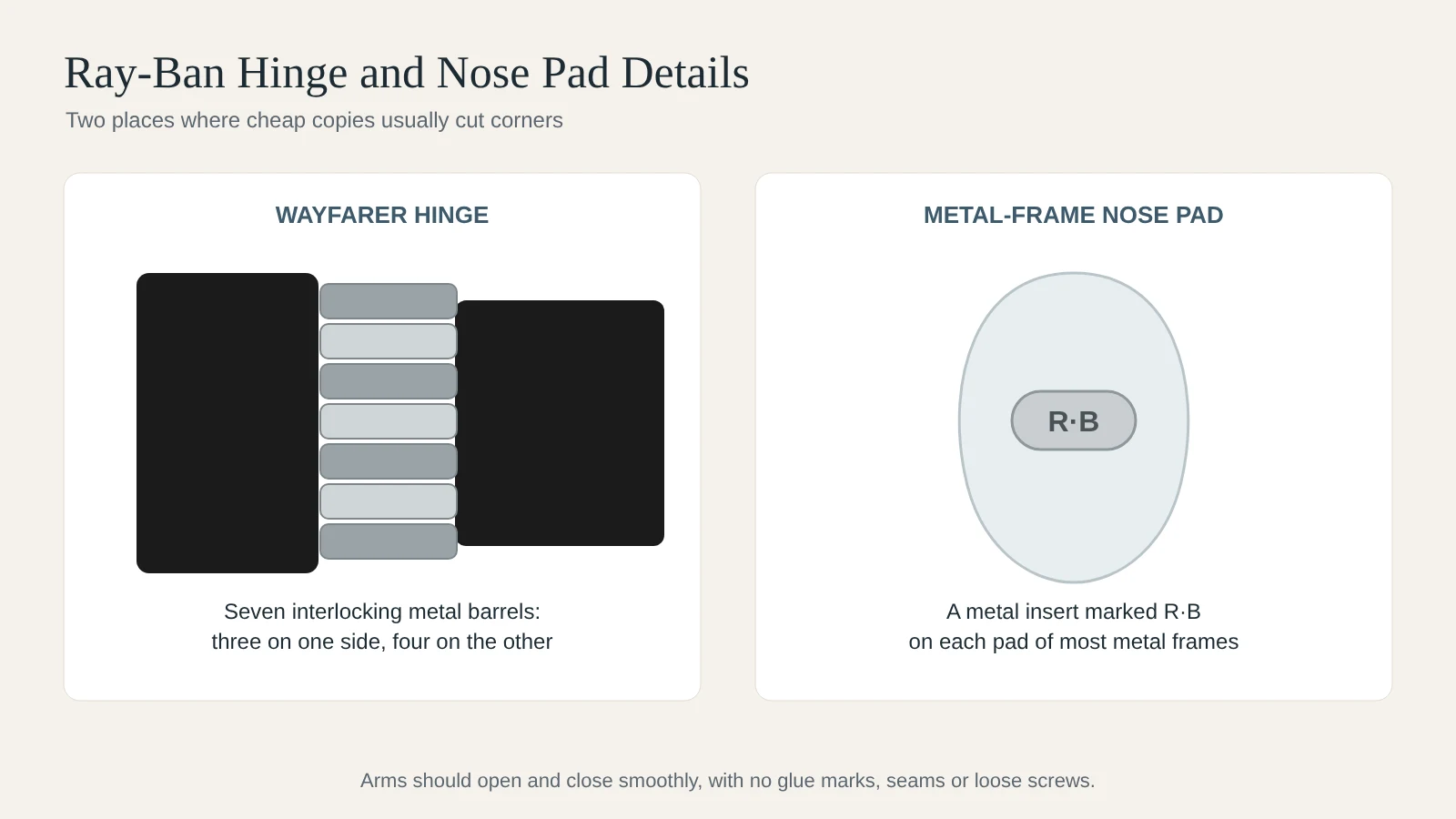
Fold and unfold the arms a few times. Genuine hinges are metal, move smoothly and feel solid, with no wobble or grinding. Acetate frames such as the Wayfarer are cut from one block of material, so you should see no seams, glue lines or rough edges where the arm meets the hinge. Plastic hinges, loose screws and arms that flop open on their own are typical of cheap copies.
5. Check the Nose Pads and Temple Tips
On metal frames with adjustable nose pads, such as the Aviator and Round Metal, each pad has a small metal insert stamped with R·B. Fakes often skip it or use plain pads. On acetate frames without pads, look at the temple tips instead: they should be smooth, rounded and evenly finished, with no sharp molding lines.
6. Look Closely at the Lenses and the Weight
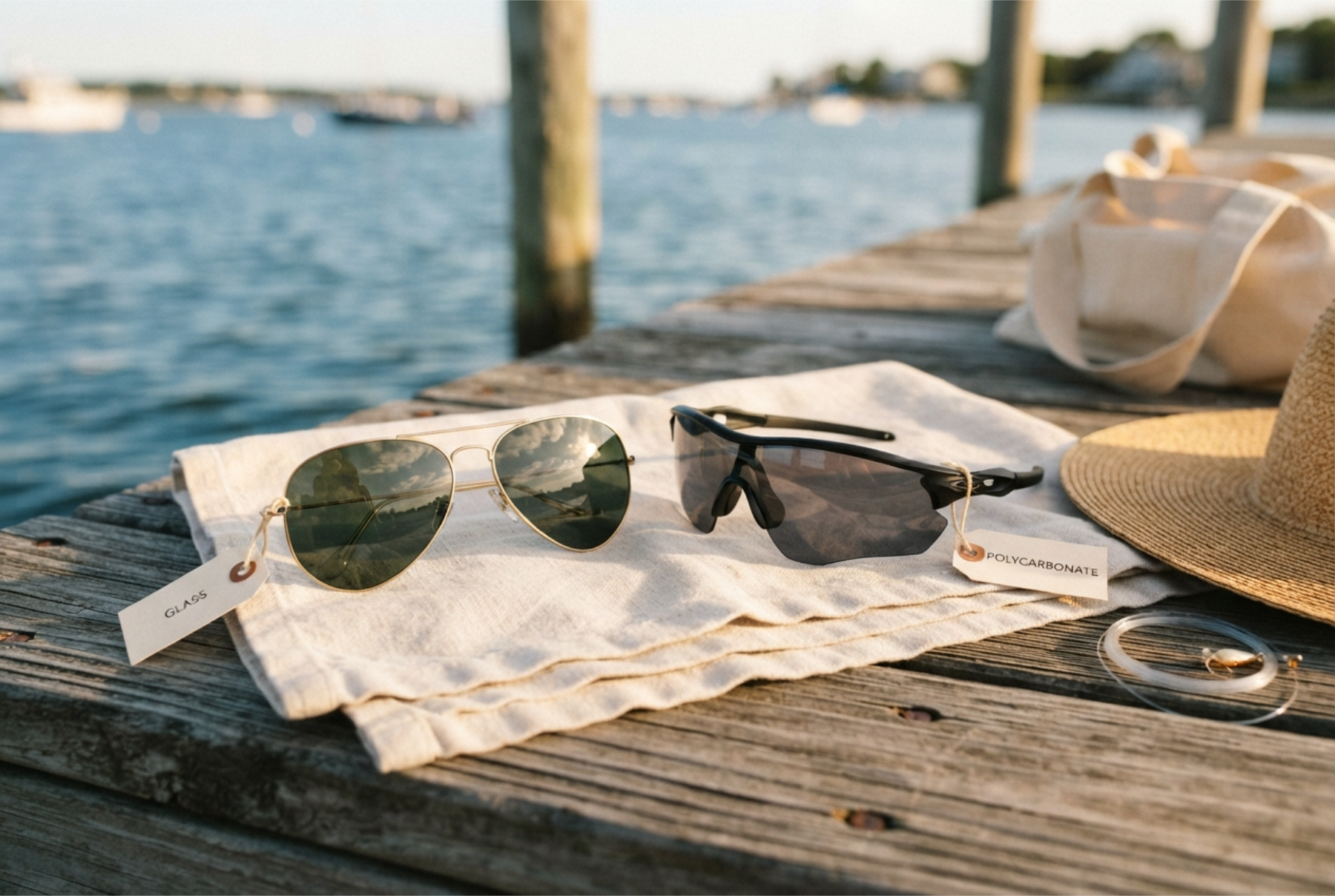
Hold the sunglasses up and look through them at a straight line, such as a door frame. Genuine lenses show it straight and sharp, while cheap lenses often bend or blur it near the edges. Real Ray-Bans also feel solid in the hand, with parts that fit together tightly. Weight alone is not a test, though: some genuine models use glass lenses and others use light plastic, as our comparison of glass and polycarbonate lenses explains.
7. Inspect the Case, Cloth and Box
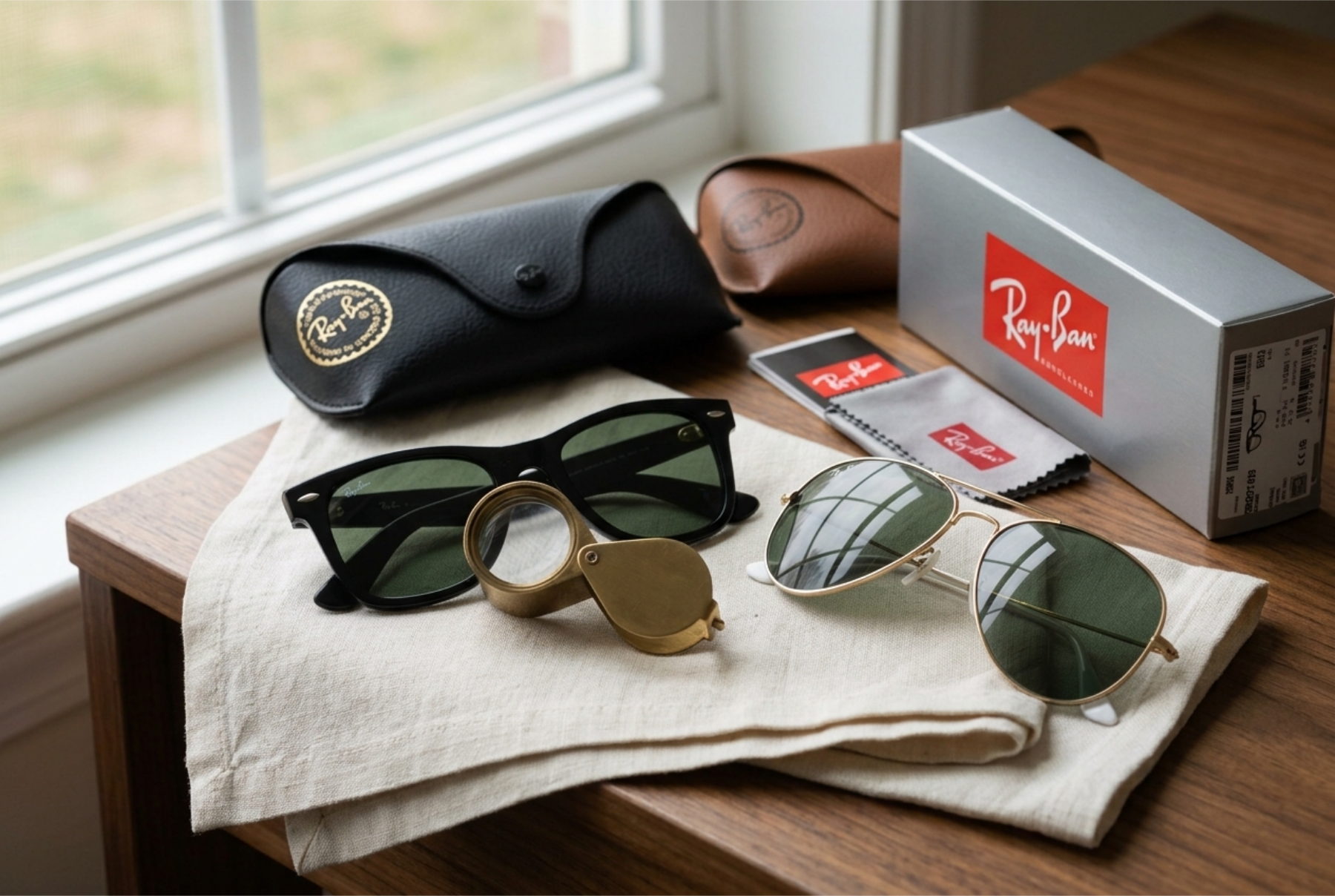
New Ray-Bans usually come in a faux leather case with the logo stamped on the snap, a microfiber cleaning cloth with the logo, an information leaflet and a box label with a barcode, the model number and the size. According to the Ray-Ban certified retailer FramesDirect, the details on the box label should match the codes inside the arm, with Luxottica named as the manufacturer. Counterfeiters can buy or copy genuine boxes, so packaging supports your verdict but never settles it. For the general packaging signs that apply to every brand, see our guide on how to tell if sunglasses are good quality.
8. Compare the Price and the Seller
Price is often the fastest giveaway. FramesDirect notes that Ray-Ban’s parent company sets strict discount rules, so a current style marked down by more than about 30 percent from its suggested retail price deserves a second look. Listings at a fraction of the usual price, sellers who cannot name the model number, and stock photos without real close-ups are all reasons to walk away. The safest route is the one U.S. Customs and Border Protection recommends for any branded product: buy from a trusted retailer or vendor, such as Ray-Ban itself or an authorized store.
Real vs Fake Ray-Bans at a Glance
The table puts the eight checks side by side. Use it as a quick reference when you shop secondhand or compare a listing with the pair in your hands.
Fake vs Real Ray-Bans by Model
The eight checks apply to every pair, but each classic model has a detail that copies tend to miss. Find yours below.
Ray-Ban Aviator: Fake vs Real
The Aviator, usually the RB3025, is the most counterfeited Ray-Ban. Start with the nose pads: each should carry a small metal insert stamped R·B. Then check the thin metal frame for even, smooth joins where the bridge meets the rims, and confirm that the arm code begins RB3025 or RB3026 and lists a lens size that matches the frame you are holding. Fake Aviators often have flimsy, bendy rims and lenses that rattle in the frame.
Ray-Ban Wayfarer: Fake vs Real
The Original Wayfarer, RB2140, is made of thick acetate with a polished, seamless finish. FramesDirect describes its hinge as seven interlocking metal barrels, three on one side and four on the other, which most copies simplify. Look for crisp edges at the front corners and a model code that reads RB2140, or RB2132 for the softer New Wayfarer. A light, hollow-feeling frame or visible molding lines suggest a fake.

Ray-Ban Clubmaster: Fake vs Real
The Clubmaster, RB3016, combines an acetate brow with thin metal rims, and that join is where copies struggle. The acetate should sit tightly on the metal with no gaps or glue, the small rivets on the brow should be neat and even, and the nose pads should carry the R·B insert. Uneven brow edges or a metal lower rim that flexes easily are warning signs.
Ray-Ban Round Metal: Fake vs Real
The Round Metal, RB3447, has very thin wire rims, so look for perfectly round lenses, clean solder points at the bridge and R·B inserts on the nose pads. Copies often have slightly oval lenses or rims that bend at the lightest touch. Check that the arm code reads RB3447 and that the lens size matches one of its standard sizes.
Ray-Ban Justin: Fake vs Real
The Justin, RB4165, is known for its soft-touch rubberized finish. Genuine frames feel evenly matte and slightly velvety all over, so a glossy, sticky or patchy finish is a warning sign. The arm code should begin RB4165, and the rubber color codes, such as 622 for rubber black, should match the frame you see.
Do Ray-Bans Have Serial Numbers?
No. Ray-Bans do not have individual serial numbers. The code inside the arm describes the model, color and size, and every identical pair carries the same one, so there is no number you can look up to confirm that one specific pair is genuine. Websites that offer a Ray-Ban serial number check are not run by Ray-Ban. The code is still worth a search, because it shows what that exact model and color should look like. A pair whose shape, tint or measurements disagree with its own code is almost certainly a copy.
Are Ray-Bans on Amazon and eBay Real?
They can be, but it depends on who is selling. Amazon is both a store and a marketplace: many Ray-Ban listings are shipped and sold by Amazon.com itself, while others come from independent sellers. Before you buy, check the “Ships from” and “Sold by” lines under the price, read the seller’s ratings and avoid listings that cost far less than everywhere else. Amazon’s A-to-z Guarantee covers you if a third-party seller sends something other than what was described.
On eBay and other resale sites, used and vintage Ray-Bans are common, so the risk is higher. Ask the seller for close-up photos of the lens etching, the inside of both arms and the nose pads, and walk away if they refuse. eBay’s Money Back Guarantee lets you return an item that does not match the listing.
Are Ray-Bans Made in China Fake?
No, a “Made in China” mark does not mean your Ray-Bans are fake. Ray-Ban makes sunglasses in both Italy and China, in factories run by its parent company, and FramesDirect confirms that China-made Ray-Bans are genuine when they come from an authorized seller. Both versions use the same materials and quality standards. Judge a pair by the eight checks above, not by the country printed on the arm.
What to Do If You Bought Fake Ray-Bans
- Contact the seller first. Ask for a refund and explain which details do not match. Keep photos of the etching, arm print and packaging.
- Use the marketplace’s buyer protection. Open a claim under Amazon’s A-to-z Guarantee, eBay’s Money Back Guarantee or the equivalent policy on the site you used.
- Call your card issuer if the seller will not help. Most U.S. credit cards let you dispute a charge for goods that are not as described.
- Report the listing. Flag it on the marketplace so it is removed. Counterfeit goods can also be reported to the National Intellectual Property Rights Coordination Center (IPR Center).
- Do not rely on the lenses. Counterfeit sunglasses are not tested to any standard, and you cannot judge UV protection by how dark a lens looks. Replace them with a pair labeled UV400 or 100% UV protection.
Frequently Asked Questions About Fake Ray-Bans
How can you tell if Ray-Bans are real?
You can tell if Ray-Bans are real by checking several details together: a faint RB etched on the left lens, a clean logo on the right lens, sharp model and color codes inside the left arm, smooth metal hinges, R·B on the nose pads of metal frames, and a price close to retail. A genuine pair passes all of them, while a fake usually fails at least two.
Do fake Ray-Bans have the RB on the lens?
Many do. Counterfeiters know that buyers look for the RB etching, so better fakes copy it, sometimes too boldly or as a print that rubs off. Real etching is faint and part of the lens surface. Treat the etching as one check among eight, and confirm it against the arm print, hinges and seller before you decide.
Are Ray-Bans made in China fake?
No. Genuine Ray-Bans are made in both Italy and China, in factories owned by the brand’s parent company, and both use the same standards. “Made in China” on the right arm is normal. What matters is whether the rest of the details match a genuine pair and whether you bought from an authorized seller.
Can you check a Ray-Ban serial number online?
No. Ray-Bans do not have individual serial numbers, and Ray-Ban does not offer an online serial check. The code inside the arm is shared by every identical pair, so it only tells you the model, color and size. Searching it is still useful: if the frame or lenses you have do not match that code, the pair is suspect.
Is the Ray-Ban case proof that a pair is real?
No. A case, cloth and box are easy to copy, and counterfeit sunglasses are sometimes packed in genuine Ray-Ban boxes. Packaging can support your verdict when the box label matches the code inside the arm, but the sunglasses themselves, and the seller, are what you should judge.
Are cheap Ray-Bans always fake?
Not always, but a big discount on a current style is the most common sign of a fake. Genuine Ray-Bans go on sale through authorized stores, usually by modest amounts. A new pair listed for a fraction of the usual retail price, especially from an unknown seller, is very likely counterfeit, however convincing the photos look.