Sunscreen Ingredients List: Every UV Filter at a Glance
Sunscreen ingredients fall into two families. Mineral filters, zinc oxide and titanium dioxide, are particles that sit on the surface of your skin and block UV rays. Chemical filters, such as avobenzone and octocrylene, are absorbed into the top layers of skin and turn UV light into a small amount of heat. If you want the full side-by-side on how the two work, our chemical vs. mineral sunscreen guide breaks it down.
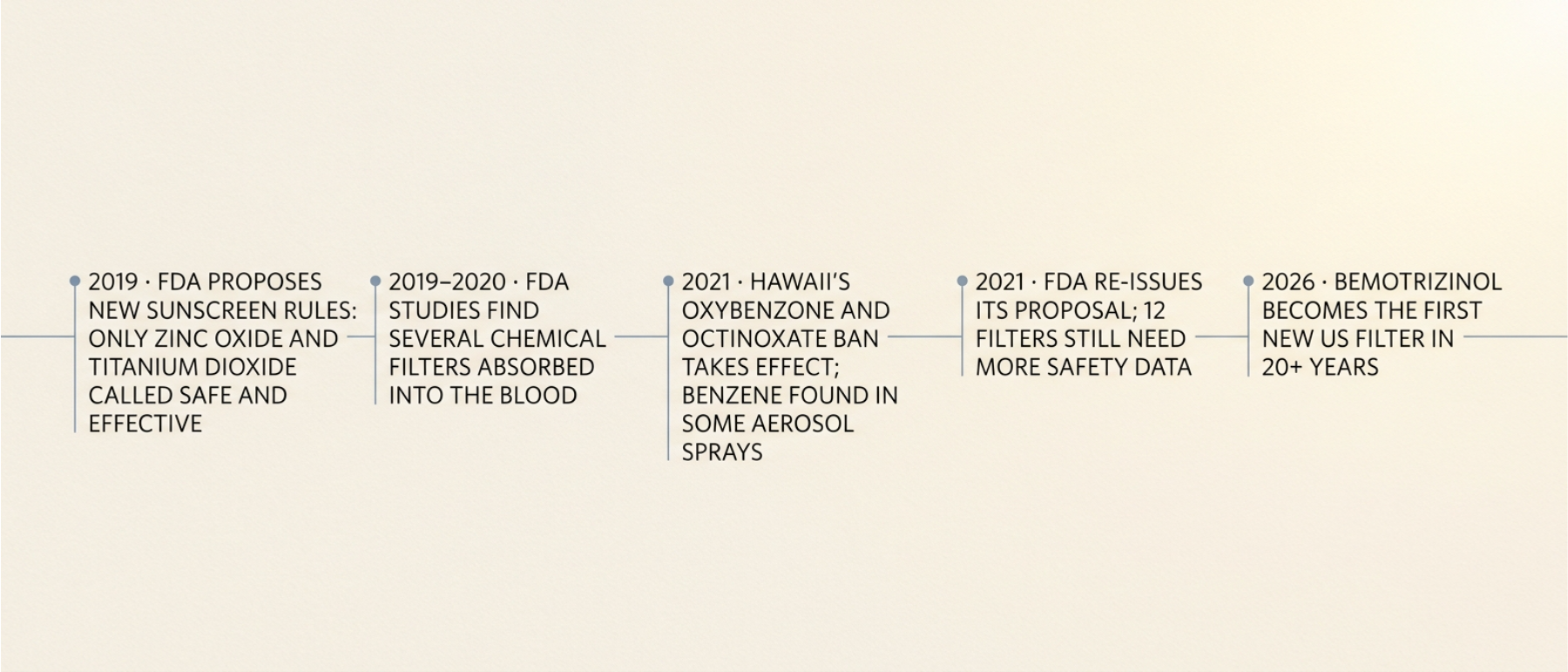
The FDA regulates sunscreen as an over-the-counter drug, so every active ingredient needs a safety rating. In 2019 the agency proposed that only two filters, zinc oxide and titanium dioxide, had enough evidence to be called safe and effective. It asked manufacturers for more data on 12 chemical filters, and as of late 2026 those reviews are still open.
"More data needed" does not mean an ingredient is proven harmful. It means the studies the FDA wants simply haven't been completed. In the agency's own words, that classification "does not represent a conclusion by the FDA" that those ingredients are unsafe.
The chart below shows where each common sunscreen ingredient stands today.
Less common FDA-listed filters, including ensulizole, meradimate, sulisobenzone, cinoxate, dioxybenzone, and padimate O, also sit in the "more data needed" group. You'll rarely see them on US shelves today.
The Safest Sunscreen Ingredients
Three filters currently hold the FDA's safe-and-effective rating, and they're the best sunscreen ingredients to look for if safety is your top priority. Two are minerals with decades of use behind them. The third, bemotrizinol, joined the list in June 2026.
All three cover both UVB, the rays behind sunburn, and UVA, the rays linked to aging and dark spots. That broad coverage matters more than any single label claim. A formula built on these ingredients is the closest thing to a no-compromise pick.
Zinc Oxide
Zinc oxide is the filter dermatologists suggest first for babies, sensitive skin, and anyone who reacts to chemical filters. As the American Academy of Dermatology puts it, "Dermatologists recommend physical sunscreens, also called mineral sunscreens, for people with sensitive skin." Its trade-off is cosmetic: higher percentages can leave a chalky film, especially on deeper skin, which is why tinted sunscreens for dark skin tones are worth a look.
Titanium Dioxide
Titanium dioxide rarely works alone, so most mineral formulas pair it with zinc for fuller coverage. In lotions and creams it's considered very low risk. The caution applies to sprays and loose powders, because inhaling the particles is a separate concern from putting them on skin.
Bemotrizinol (Tinosorb S)
Bemotrizinol is a big reason so many shoppers order Korean sunscreens online, where it has been standard for years. Its US approval lets American brands offer that same lightweight, broad-spectrum protection without leaning on oxybenzone. Expect it to appear on drugstore labels gradually as brands reformulate.
Sunscreen Ingredients to Avoid (and Why)
Not every ingredient on this list carries the same level of concern, so think of it as a ranking rather than a blacklist. Oxybenzone and octinoxate have the most research behind the worries and are the easiest to skip. The others are situational: worth avoiding if you're pregnant, have reactive skin, or simply prefer a mineral formula.
One finding ties the group together. FDA studies published in JAMA in 2019 and 2020 found that six common chemical filters reach the bloodstream at levels above the threshold that triggers further safety testing. The researchers were clear that people should keep wearing sunscreen. Absorption tells you which ingredients need more study, not that they cause harm.
Two filters on this list, oxybenzone and octinoxate, are also banned in Hawaii for their effect on coral. Our reef-safe sunscreen guide covers what to pack for a beach trip.
Oxybenzone (Benzophenone-3)
Oxybenzone has the longest list of open questions of any sunscreen filter. Lab and animal studies link it to weak hormone-like activity, and a CDC survey found it in the urine of nearly all Americans it sampled. Pregnant women and parents of young kids are usually advised to skip it first, and since many brands have already reformulated, oxybenzone-free sunscreen is easy to find.
Octinoxate (Octyl Methoxycinnamate)
Octinoxate was one of the most widely used filters in drugstore sunscreen for decades, which is why it still turns up on so many labels. Animal studies show it can mimic hormones, and it shares oxybenzone's reef concerns, which is why the two usually get dropped together.
Homosalate
Homosalate is a workhorse in sport and water-resistant formulas. European safety reviewers decided the old limit was too high and cut it back sharply in 2022, which makes it the clearest case where US and EU rules now disagree. If you're comparing two otherwise similar sunscreens, the one without homosalate is the more conservative choice.
Octocrylene
Octocrylene is often added to keep avobenzone working longer, so it turns up in many popular formulas. A 2021 French study found it slowly breaks down into benzophenone, a possible carcinogen, as products sit on the shelf. If your sunscreen contains it, treat the expiration date as a hard rule and toss last summer's bottle.
Avobenzone
Avobenzone is the main UVA filter in most US chemical sunscreens, so avoiding it entirely leaves few non-mineral options. Its real weakness is stability, since it loses strength in sunlight unless a formula protects it, and some people develop allergic reactions to it. Consider it a softer "avoid" than oxybenzone.
Octisalate (Ethylhexyl Salicylate)
Octisalate is a mild filter used mostly to help other ingredients spread evenly. It's the least worrying chemical filter here, with occasional irritation as the main reported issue, though it still waits on the same FDA review as the rest.
What to Look For in a Sunscreen
If you only remember one part of this guide, make it this checklist. It turns the chart above into quick shopping rules you can use in any store aisle or on any product page.
Remember: a sunscreen you'll reapply every day protects you more than a "perfect" formula that sits in a drawer.
Inactive Ingredients Worth Checking
The active filters get the headlines, but the inactive list is where most skin reactions start. These are the ingredients behind the formula's texture, scent, and shelf life, and they're listed under Inactive Ingredients on the label.
CDN filename: sunscreen-inactive-ingredients-icons.webp
Alt text: Icons for sunscreen inactive ingredients to check in 2026: parabens, fragrance, benzene, phthalates, acrylates
- Fragrance and essential oils. Fragrance is one of the most common causes of allergic reactions to cosmetics. If your skin stings or turns red after sunscreen, a fragrance-free formula is the first swap to try.
- Parabens. These preservatives keep bacteria out of the bottle. The FDA says there's no evidence they're harmful at cosmetic levels, but paraben-free options are widely available if you prefer to skip them.
- Benzene. Benzene is never an ingredient; it's a contaminant. In 2021 it turned up in some aerosol sunscreens, and Johnson & Johnson recalled five Neutrogena and Aveeno sprays. See our sunscreen sprays guide for formulas sorted by filter type.
- Phthalates. You won't usually see them by name, since they can hide inside the word "fragrance." Choosing fragrance-free sunscreen avoids most of them.
- Acrylates. These film-formers help water-resistant sunscreens stay put. They're safe for most people but a known trigger for contact allergies in a small group.
How to Read a Sunscreen Label
US sunscreen labels follow the same Drug Facts layout, which makes them faster to read than most skincare packaging once you know where to look. The Skin Cancer Foundation recommends the same order of checks we use below.
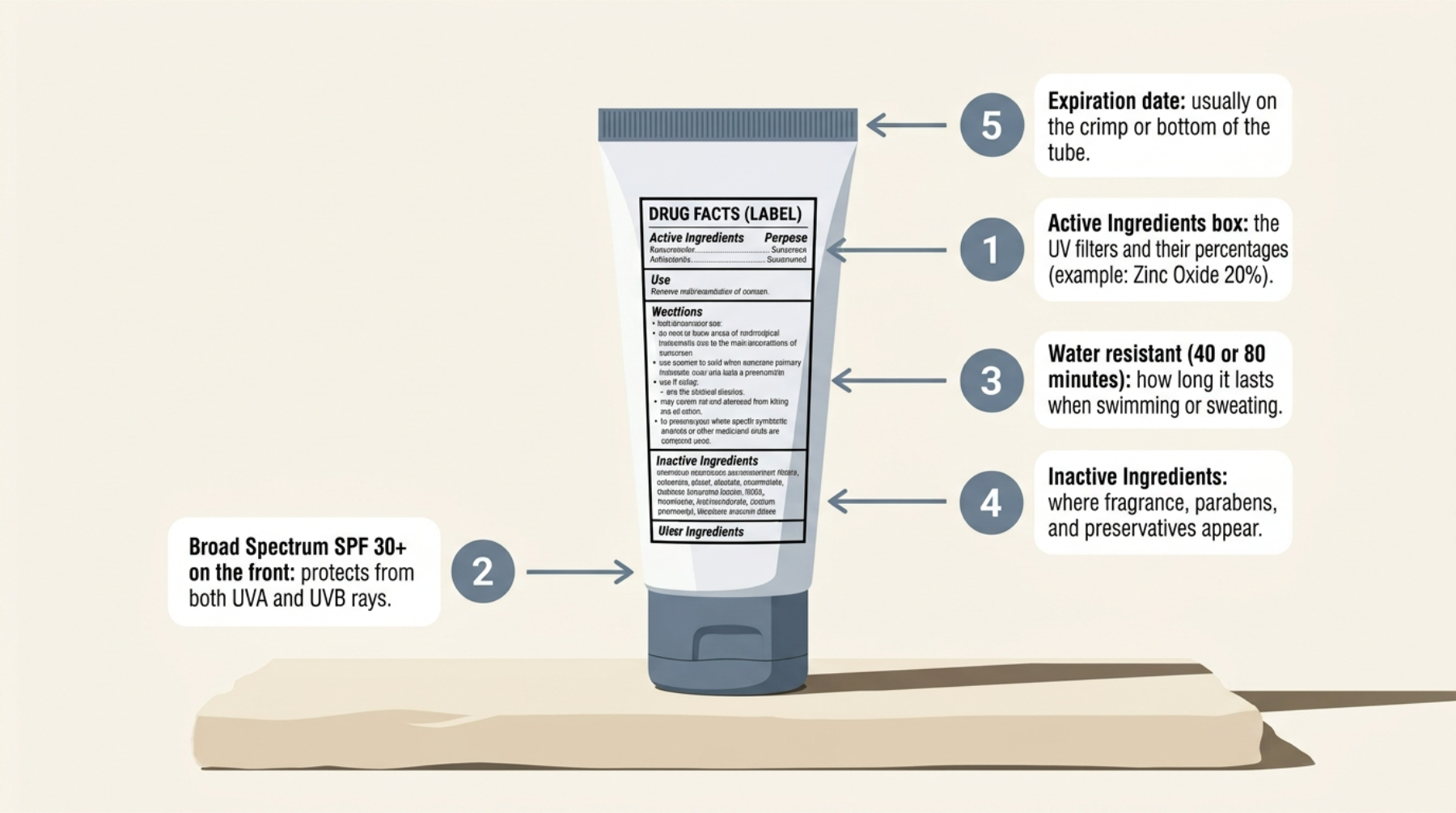
- Active Ingredients. This box lists every UV filter and its percentage, for example "Zinc Oxide 20%" or "Octinoxate 7.5%." It's the only place that tells you what's actually protecting your skin.
- Broad Spectrum SPF 30+. "Broad spectrum" means the formula passed the FDA's UVA test. SPF only measures UVB, so you want both on the front.
- Water resistance. Labels can claim 40 or 80 minutes, never "waterproof." Our water-resistant sunscreen guide explains what those numbers mean for swimming.
- Inactive Ingredients. Scan here for fragrance, essential oils, and any ingredient you already know your skin dislikes.
- Expiration date. Usually stamped on the crimp or bottom of the tube. If there's no date, the FDA has a simple rule.
Hormone Disruptors, Pregnancy, and Sunscreen
Concerns about sunscreen and hormones center on a few chemical filters. Oxybenzone has the strongest evidence of weak hormone-like activity, followed by octinoxate and homosalate, mostly from lab and animal studies using high doses. Studies in people are limited and mixed, so there's no proof that normal sunscreen use disrupts human hormones.
For pregnancy, many dermatologists simply recommend mineral sunscreen to sidestep the question. Zinc oxide and titanium dioxide aren't meaningfully absorbed, they rarely irritate skin that's more sensitive during pregnancy, and they help with the melasma that often appears in those months. If dark patches are already showing up, our sunscreens for hyperpigmentation and melasma are a good place to start.
The simplest non-hormone-disrupting choice: a sunscreen whose only active ingredients are zinc oxide and/or titanium dioxide.
Sunscreen Myths vs. Facts
A lot of what circulates about toxic sunscreen online mixes real research with leaps it doesn't support. These are the four claims we see most often, and what the evidence says.
Want the short version for your next shopping trip? Save the cheat sheet below.
CDN filename: sunscreen-ingredients-to-avoid-cheat-sheet.webp
Alt text: Sunscreen ingredients cheat sheet 2026: safest filters, ones needing more data, and ones to skip
Where to Shop by Skin Need
Once you know which ingredients you want, the next step is finding a formula that fits your skin. Each guide below is sorted around the filters covered here.
Frequently Asked Questions About Sunscreen Ingredients
What is the safest ingredient in sunscreen?
Zinc oxide is the safest sunscreen ingredient for most people. It's one of only three filters the FDA classifies as generally recognized as safe and effective, it blocks both UVA and UVB rays, and it's gentle enough for babies and sensitive skin. Titanium dioxide and bemotrizinol share the same FDA rating. Zinc oxide stands out because it covers the widest UV range on its own.
What ingredients should you avoid in sunscreen?
Oxybenzone is the first sunscreen ingredient to avoid, followed by octinoxate. Both are absorbed into the body, show hormone-like effects in animal studies, and are banned in Hawaii for harming coral reefs. Homosalate and octocrylene are next if you want a more cautious formula. On the inactive side, fragrance is the ingredient most likely to irritate your skin.
Is sunscreen bad for you?
No. Sunscreen is one of the most effective ways to prevent skin cancer and early aging, and dermatologists recommend a broad-spectrum SPF 30 or higher every day. The open questions involve a few specific chemical filters, not sunscreen as a whole. If those filters concern you, switching to a mineral sunscreen with zinc oxide or titanium dioxide removes them entirely without giving up protection.
What is the main active ingredient in sunscreen?
There isn't one single active ingredient. Each sunscreen uses one or more UV filters, listed with percentages in the Active Ingredients box. Zinc oxide is the most common mineral filter, and avobenzone is the most common chemical filter for UVA protection in the US. Many chemical sunscreens combine four or five filters, since each one covers a different part of the UV spectrum.
What sunscreen ingredients are banned in the US?
PABA and trolamine salicylate are the only sunscreen ingredients the FDA has formally removed. Its September 2026 final order classifies both as not safe and effective, and the agency says no current US sunscreens use them. Oxybenzone and octinoxate aren't banned nationwide, but Hawaii has prohibited sunscreens containing them since 2021.
Are parabens in sunscreen bad for you?
Parabens in sunscreen aren't considered harmful at the low levels used in cosmetics, according to the FDA. They're preservatives that stop bacteria and mold from growing in the bottle, which keeps the formula safe to use. Some people prefer paraben-free sunscreen as a precaution, and plenty of mineral and sensitive-skin formulas skip them.
Is there benzene in sunscreen?
Benzene is not a sunscreen ingredient, but it has been found as a contaminant in some products, mostly aerosol sprays. In 2021, an independent lab's testing led to several recalls, including five Neutrogena and Aveeno sprays. Lotions and sticks have had far fewer problems than aerosols. Checking the FDA's recall list before buying a spray is a simple precaution.
Sources We Checked
Every fact in this guide was checked against the sources below. Last reviewed: October 14, 2026.
This guide is for general information and isn't medical advice. If you're pregnant, have a skin condition, or react to sunscreen, check with a dermatologist about the right formula for you.